Following the K2 lineup, Creality is taking a major technological turn with the K3. Showcased at IFA 2026 in Berlin (where it earned an IFA Innovation Award) and now fully detailed on Creality's official product page, the printer introduces the company's proprietary KliTek™ automatic nozzle-changing system. Early uncertainties around build volume, operating temperatures, and kinematics are now resolved. Here is the full breakdown of verified official specs.
Confirmed by Creality: 4-nozzle KliTek system (4.8s swaps), 260 × 260 × 260 mm volume, 500 mm/s print speed, 20,000 mm/s² acceleration, 300 °C hotend, S-Drive™ TPU feed system, and a scheduled October 2026 release. Not disclosed to date: official retail price.
Where things stand
The K3 is no longer just a teaser clip. At IFA 2026, Creality had working units on its booth producing multicolor and multi-material parts in real time. Shortly after, the brand launched the official product page on its website, confirming direct retail availability (bypassing Kickstarter or crowdfunding platforms) with a launch window set for October 2026.
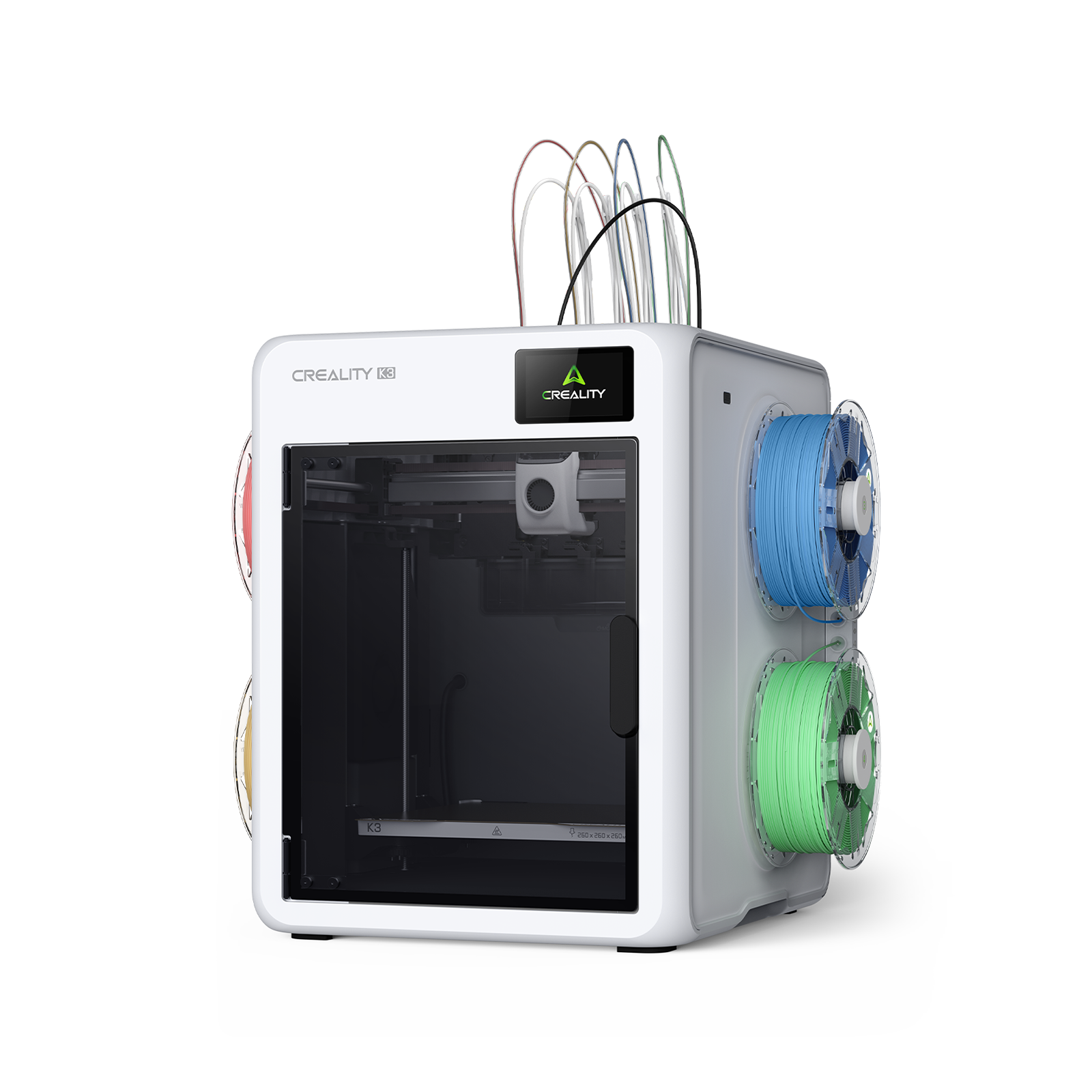
Visually, the machine departs from the utilitarian dark aesthetic of the K1 and K2 series: it features a soft-white chassis with rounded corners, a front 3.97-inch color touchscreen, and four filament spools mounted two-by-two on the outer left and right panels.
KliTek: the 4.8s nozzle-changer
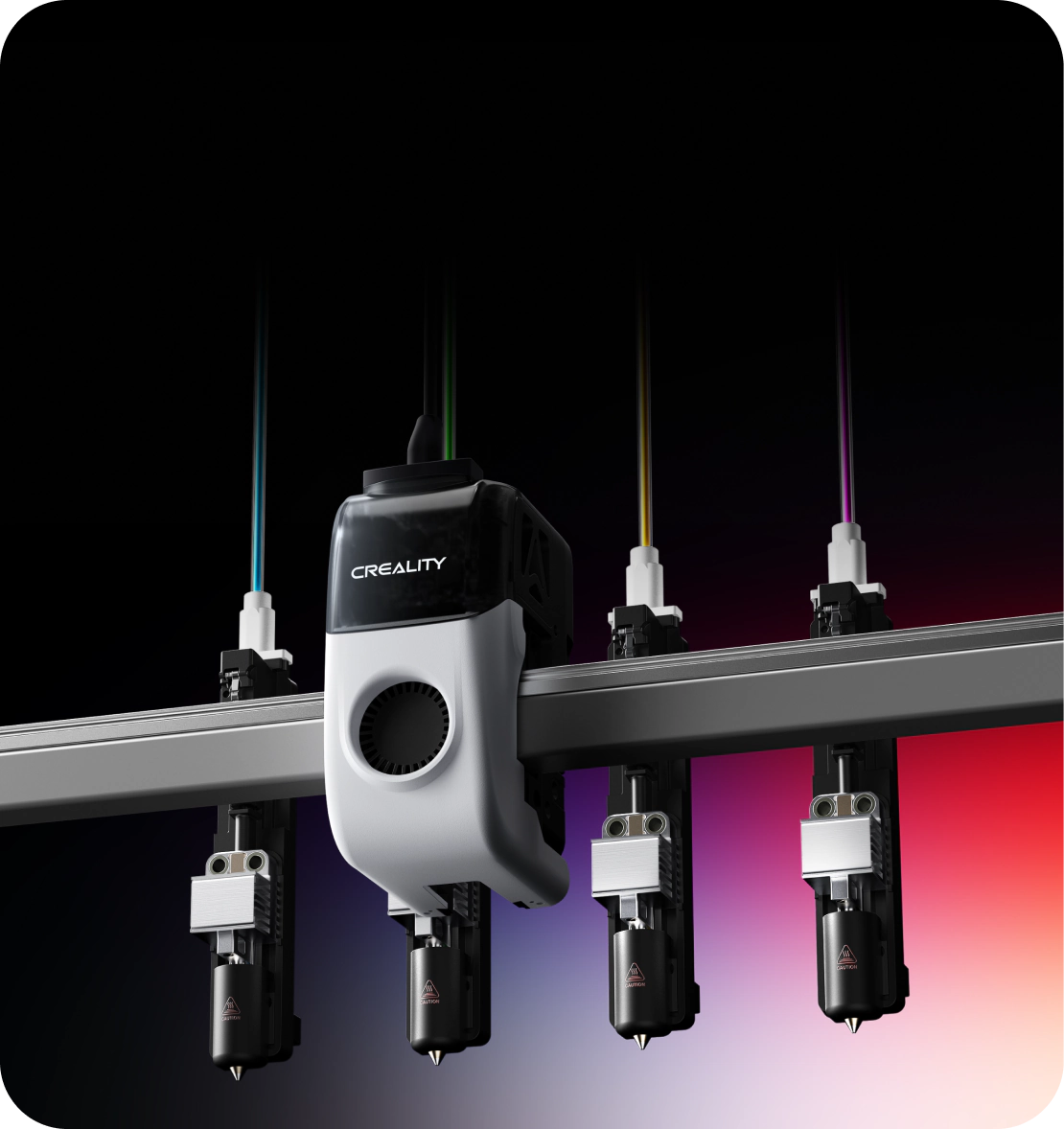
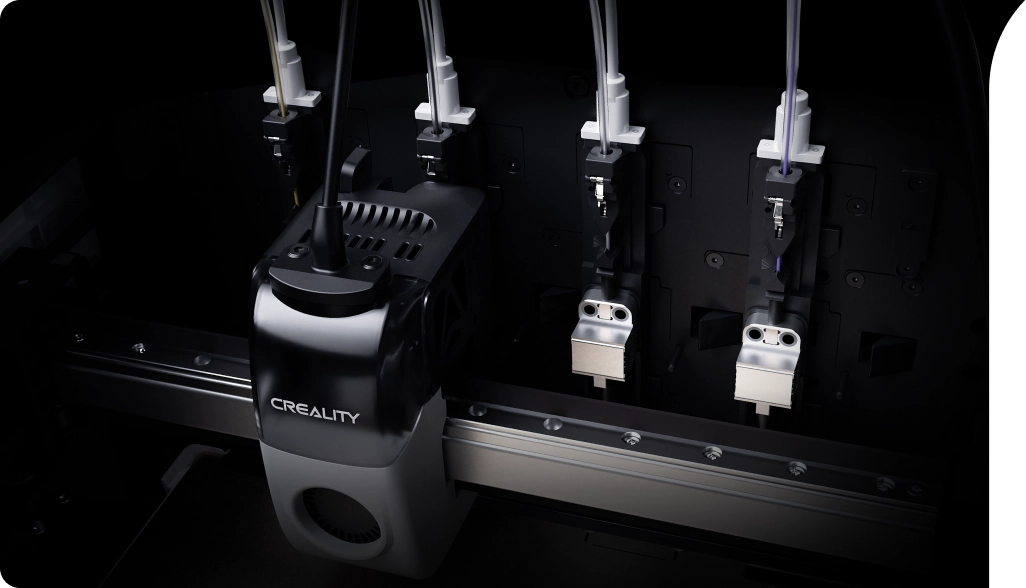
The centerpiece of the K3 is its KliTek™ mechanism. Rather than a full toolchanger moving an entire heavy extruder per channel, or a single-nozzle purge setup (Bambu AMS, Creality CFS), KliTek uses an intermediate approach:
- Only the nozzle assembly is swapped: the moving carriage swaps the hot block + nozzle + thermal break + filament tube. The primary drive extruder motor remains on the carriage, minimizing moving mass and preserving sharp acceleration.
- 4 independent nozzles: docked neatly along the rear internal frame, each nozzle stays pre-threaded with its own filament and features independent PTC pre-heating.
- Ultra-fast 4.8s swap: docking and locking a nozzle takes 4.8 seconds, with a complete color or material transition completing in 15 seconds.
- Sub-25 µm repeatability: the XYZ kinematic docking interface delivers repositioning drift below 25 µm (≤ 0.025 mm), stress-tested by Creality across more than 600,000 continuous nozzle changes.
- 37 integrated sensors: including 12 sensors dedicated exclusively to docking alignment, latch engagement, and thermal contact verification.
- Quick USB-C maintenance: each nozzle module connects via a dual-screw USB-C interface. In the event of wear or a stubborn clog, the entire nozzle assembly is replaced in seconds without tearing down the printhead.
According to Creality Lab benchmark data, eliminating filament purge cycles cuts filament waste by up to 85% and total print time by up to 80% on dense multicolor models, while eliminating color bleeding between contrasting layers.
Official technical specifications
Below are the official specifications confirmed on Creality's technical sheet:
| Feature | Official Specification (Creality K3) |
|---|---|
| Technology | Fused Filament Fabrication (FFF / FDM) |
| Build Volume | 260 × 260 × 260 mm |
| Toolchanging Architecture | KliTek™ · 4 channels / 4 independent nozzles |
| Nozzle Swap Time | 4.8 seconds (material change: 15s) |
| Repositioning Accuracy | ≤ 25 µm (XYZ repeatability) |
| Max Print Speed | 500 mm/s |
| Max Acceleration | 20,000 mm/s² |
| Extruder & Motor | Hardened steel dual-gear direct drive · closed-loop FOC step-servo (-7 dB) |
| Max Nozzle Temperature | 300 °C |
| Heated Bed | Textured PEI spring steel · up to 100 °C |
| Supported Nozzle Sizes | 0.2 / 0.4 / 0.6 / 0.8 mm (ships with 0.4 mm; multi-nozzle kit optional) |
| Layer Height Range | 0.08 – 0.35 mm (with standard 0.4 mm nozzle) |
| Sensors | 37 built-in sensors (12 dedicated to nozzle docking) |
| Camera & AI | 720p with lighting: spaghetti detection, build plate check, foreign object scan |
| Filament Spools | 4 × 1 kg chassis-mounted spools · integrated Creality RFID reader |
| Air Filtration | Integrated HEPA + activated carbon filters |
| Chamber Heating | Passive (sealed via optional Top Cover, no active heater) |
| Control Interface | 3.97-inch color touchscreen |
| Connectivity & OS | 2.4 GHz Wi-Fi, USB drive, Creality Cloud · Native Root access |
| Slicing Software | Creality Print 7.0 or newer (G-code / 3MF) |
| Dimensions & Weight | 420 × 482 × 536 mm · 22 kg |
| Rated Power | 480W (100–127V) / 950W (200–240V) · Standby: ~160W |
Materials, TPU & mixed nozzles
Beyond cosmetic color, KliTek unlocks practical engineering capabilities:
- S-Drive™ TPU Extrusion: flexible filaments are notoriously difficult in long PTFE tubes. Creality built a "push & pull" feed system named S-Drive™ paired with high-flow nozzles. It supports TPU ratings of 85A, 90A, and 95A (and down to 80A) with volumetric flow rates up to 15 mm³/s—reportedly up to 7 times faster than standard consumer setups.
- Mixed Nozzle Diameters (e.g., 0.4 + 0.8 mm): Creality Print 7.0 allows assigning two different nozzle diameters on the same model. A 0.4 mm nozzle draws crisp perimeter walls, while a 0.8 mm nozzle blazes through internal infill. Creality claims up to a 30% print time reduction, aided by an automatic mechanical interlocking toolpath algorithm at boundary layers.
- CMYK True-Color Blending: using four calibrated translucent filaments (Cyan, Magenta, Yellow, White/Grey), the slicer modulates layer thicknesses to blend light and reproduce over 25 hues and continuous surface gradients without manual painting.
- Zero-Adhesion Support Interfaces: easy pairing of PLA with PETG interface layers (or vice versa), or PVA water-soluble supports without purging yards of expensive dissolvable filament into waste bins.
Chamber & enclosure: the Top Cover
One major question was whether the K3 features active chamber heating like the K2 Plus.
The official answer is no. The standard K3 has an open-top frame. To print temperature-sensitive engineering filaments (ABS, ASA, PC, PA, PP-CF), Creality offers an optional accessory called the Top Cover:
- The Top Cover seals the upper opening, trapping heat radiated from the 100 °C bed.
- Internal air is cycled through the built-in HEPA and activated carbon filtration system to trap ultrafine particles and VOC emissions.
- This provides passive thermal insulation, suitable for medium-sized ABS or ASA prints, but lacks the active, thermostat-controlled chamber heater found on high-end industrial printers (such as the K2 Plus chamber heated to 60 °C).
Will there be a K3 Plus or K3 Max?
Across maker forums and social media, the announcement of the K3 naturally prompted questions: will Creality release a K3 Max (300 mm) or a K3 Plus (350 mm) with a heated chamber, following the path of the K1 and K2 families?
To date, Creality has not announced or confirmed any K3 Plus or K3 Max. No roadmap, trademark filing, or technical document has been issued by Creality for any size other than the standard 260 mm K3.
The K3 showcased at IFA 2026 is currently the sole machine of its generation in Creality's official catalog. Users requiring a massive 350 mm volume or an actively heated chamber should look to the existing Creality K2 Plus.
KliTek vs the competition
How does KliTek compare with current multi-material architectures?
- vs Single-nozzle with purge (Bambu AMS, Creality CFS): KliTek eliminates the prime tower and constant filament retractions. Speed and material savings on dense multicolor prints are massive, and dedicated nozzles prevent pigment contamination. On the flip side, KliTek is fixed at 4 channels (you cannot daisy-chain modules to reach 8 or 16 colors like on an AMS/CFS).
- vs Full toolchangers (Prusa XL): the Prusa XL swaps a complete toolhead (dedicated direct-drive motor on every tool). KliTek swaps only the hotend/nozzle cartridge. Creality benefits from a much lighter carriage and lower replacement costs per tool, though soft flexible filaments still travel through an assisted Bowden tube (S-Drive).
- vs Dual-nozzle systems (Bambu H2D, IDEX): dual-head machines are capped at two materials. KliTek delivers four distinct nozzles without cutting into bed stroke on the X-axis.
For a detailed breakdown of all current systems, read our multi-tool 3D printers landscape.
Price & release: should you wait?
Regarding market availability:
- Price: Creality has not yet announced the official retail price for the K3. Any figures circulating on forums remain unconfirmed rumors.
- Release date: The official commercial launch is scheduled for October 2026.
Our verdict: If you print daily and your main goal is waste-free multicolor printing, mixed-diameter nozzle speeds, or high-flow TPU, the K3 is well worth keeping an eye on—its mechanical swap mechanism represents a genuine architectural breakthrough over traditional purge systems. If you need a printer right now, or require a massive 350 mm build volume with an actively heated chamber, an existing machine like the K2 Plus or a printer from the Bambu lineup remains your best immediate option.